The Luilu Story
Powering Luilu: Assessing Electrification Pathways in a Mineral-rich Region
Context
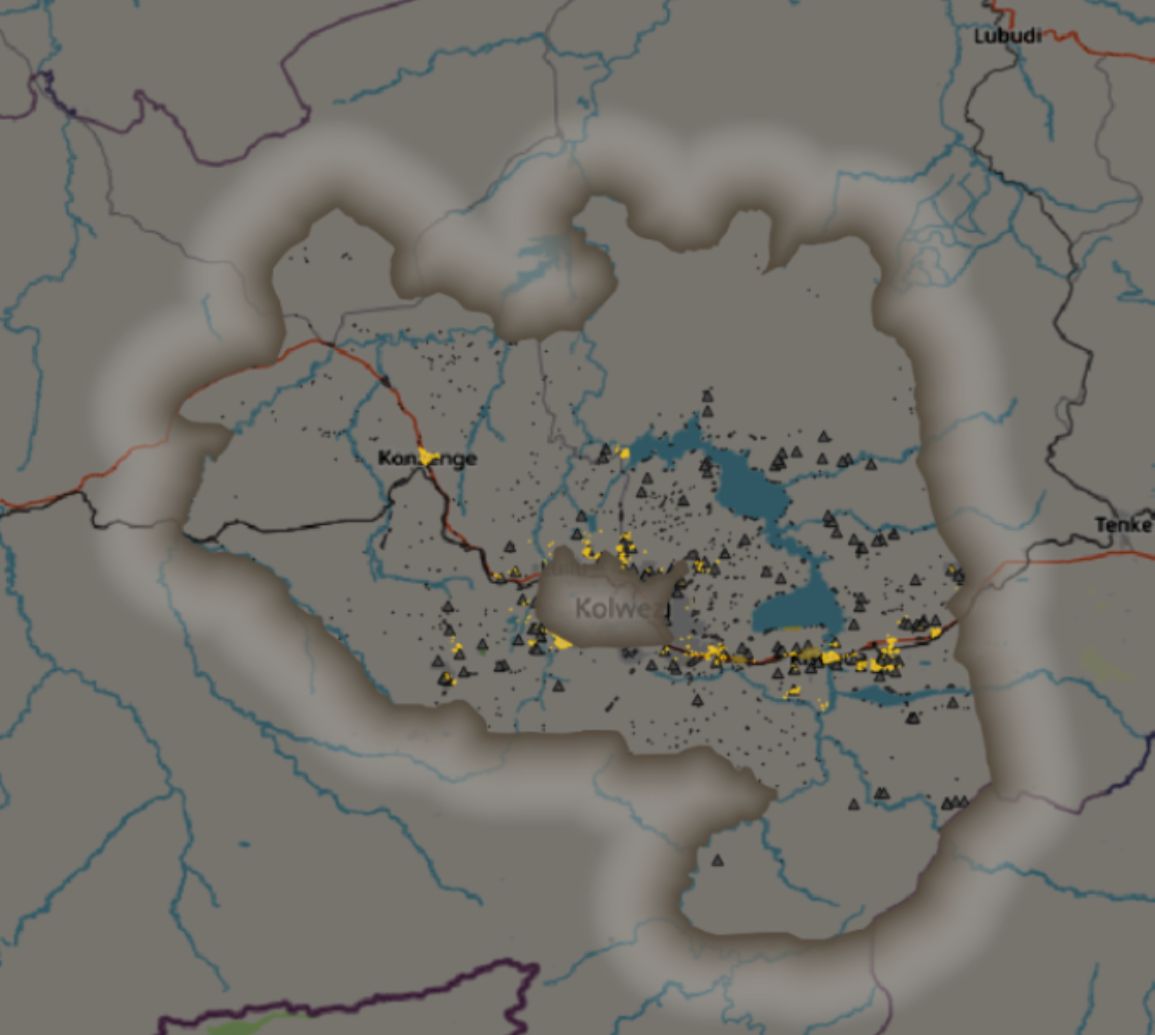
Luilu is a secteur located in the Lualaba Province, at the start of DRC’s Copperbelt, which surrounds Kolwezi City, and with it, is one of the epicentres of copper and cobalt production in DRC. Companies such as Glencore’s subsidiaries Kamoto Copper Company and Mutanda Mining, Chemaf, and Metalkol have mining sites there. This booming mining activity, however, has yet to translate into a high standard of living. Electrification access is proof of this. Currently, according to our calculations, which are optimistic as they overestimate access to electricity in territories close to mines, only 50% of the population has at least some access to electricity. We use night lights as an indicator of the electricity access. Since some mining sites are illuminated throughout the night, this methodology overestimates electricity access in the vicinity of mines.
Luilu: A Scattered Region
Yet, there's a catch to these figures. The electrification data in the country are not neatly compiled, leaving a reliability gap. To fill in the blanks, we turn to satellite images capturing nighttime lights, a proxy for estimating electrification access. However, it's not a perfect one. Take, for instance, the areas surrounding mining sites – they operate round the clock, creating a glow in satellite imagery even in places without actual electricity access. Indeed, many of the areas of the city illuminated at night are close to mining sites.
A Mining Sector
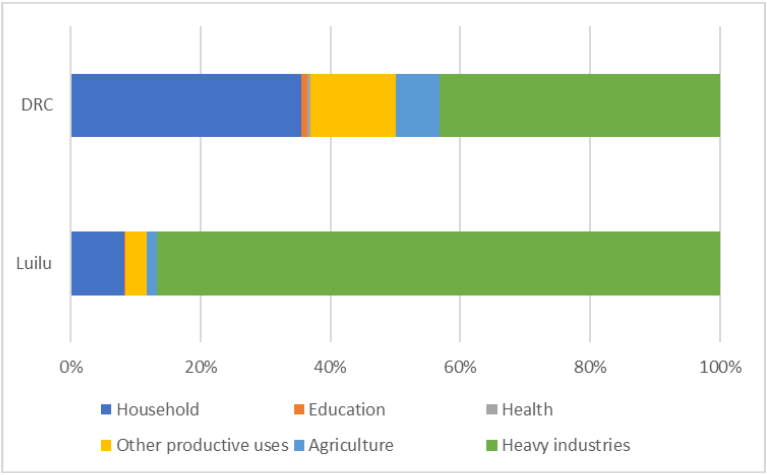
Hosting a dynamic mining industry, electricity demand in Luilu is significantly higher than the national average. According to our estimates, by 2030, per capita annual demand in Luilu will be around 1,700 kWh vs. 350 kWh in the DRC, which is explained by the difference in mining activity. The graph below compares the shares of diverse demand types in Luilu against DRC, and it highlights how much more electricity is demanded in Luilu for heavy industries, which includes mining, in comparison to the rest of the country.
Model and Scenario Description
With this context in mind, let’s see how to provide full electricity to Luilu in the future. First, though, some explanation of what we are doing here. To find the best way to bring electricity to every community in Luilu without breaking the bank, we compare the costs - the levelized cost of electricity or LCOE, to be more exact - of four possible electrification technologies: extending the current grid, installing solar or hydro mini-grids, and installing solar home panels. After doing some number crunching, we select the technology with the cheapest cost. The costs depend on supply and demand factors. Supply factors relate to the amount of energy available (e.g. solar irradiation in a community), the distance to an energy source (e.g. a potential hydro mini-grid), and the costs associated with transforming that energy into electricity (costs of building plants, networks, etc.). Demand factors relate to the potential consumption of energy in a community. A high potential consumption would make it more appealing to develop more costly technologies.
Model and Scenario Description
Since the future is uncertain, we initially imagined two scenarios: one with clean energies (solar panels, and solar, hydro, and wind mini-grids) and diesel (at 1.83 USD/gallon) and another with only clean energies. For context, diesel price in DRC changes drastically according to where you are. In Kinshasa, for instance, it costs 1.2 USD/gallon. In more remote territories, the price can easily be more than that. In a sample of 20 territories for which we have data, the average price is 1.83 USD/gallon (the price that we used), with prices going up to 2.2 (Kaniama in Haut-Lomami), 2.7 (Kibombo in Maniema) or even 3.1 (Shabunda in Sud-Kivu). There are other parameters besides diesel price. Population growth, for instance, is one of the most important to define how much electricity will be demanded in the future. We used 3.15%, the moderate population growth rate from the UN DESA. Additionally, we used a future annual electricity demand of 82 kWh per year per person, moderate growth rates for other demand types, and PV costs of 1.39 USD per kwh. These parameters were left untouched in the two scenarios to evaluate only the effect of using diesel or not.
Modelling Results
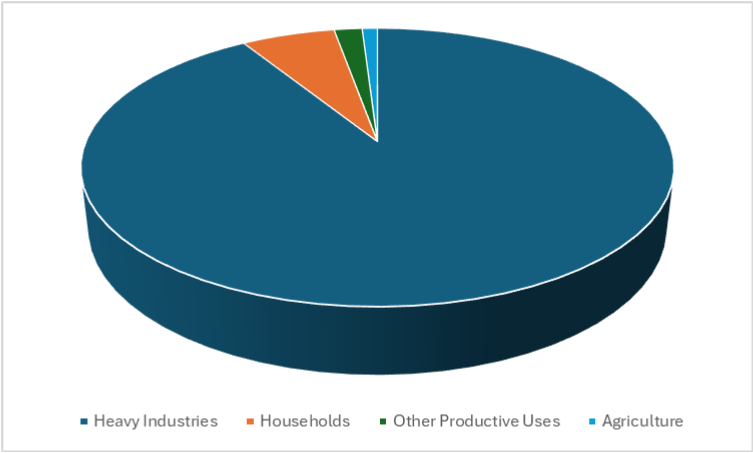
So, let's peek into the future – according to our calculations, by 2030, around 430 thousand people will call Luilu home. This population will have an annual electricity demand of almost 0.43 GWh. That's not far off from what Haiti used in 2021 (0.35 GWh) with its 11.45 million people or Greenland (0.58 GWh) with its 56,653 residents, going by figures from the U.S. Energy Information Administration. As described before, most of this electricity demand, 91%, will come from the heavyweights – mining and big industries. Electricity demand of households will make up a modest 6% of the total, while other productive uses, i.e. small and medium businesses across various sectors (excluding health and education), will have a 2% share. Last but not least, agriculture wraps up the demand roster with a 1% contribution.
Modelling Results
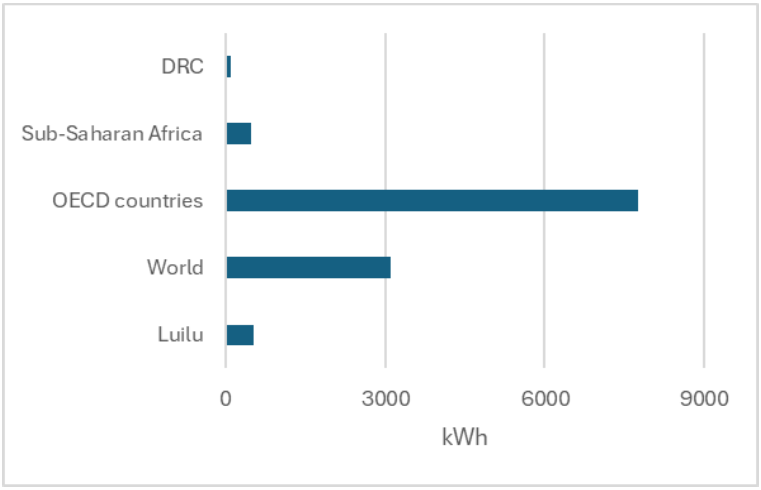
By 2030, according to our calculations, the typical resident of Luilu is projected to have an annual electricity demand of 1,016.50 kWh. In comparison, as of 2014, the global average stood at 3,105 kWh, 7,761 kWh among OECD countries, 482 kWh in Sub-Saharan Africa, and 105 kWh in the Democratic Republic of the Congo (DRC), according to the World Bank. This highlights the challenging electrification scenario in the DRC and that Luilu is faring relatively well in comparison to both the country and the broader subcontinent. Note also that we are talking about electricity “demand” and “consumption”, two terms that should not be confused. While demand refers to a population’s electricity needs whether or not these needs are met, consumption indicates the electricity that the population actually uses. In DRC we talk about electricity demand to account for the fact that the population's electricity consumption is not enough to meet their needs.
No Diesel
So, how can Luilu satisfy this demand and achieve full electrification by 2030? Interestingly, under the conditions mentioned (diesel price of 1.83 USD/gallon, population growth of 3.15%, etc.), going all-in on clean energy sources turns out to be the smarter, and most budget-friendly move compared to also relying on diesel. In both scenarios (with or without the possibility of choosing diesel), diesel is never selected. This holds for the entire DRC, not just Luilu. This implies that solar, wind, and hydro power are not only environmentally friendly but also cheaper for generating electricity than using diesel generators. It also highlights that encouraging investments in these energy alternatives by territorial authorities can play a significant role in increasing electrification in their jurisdictions.
Future Technology Mix
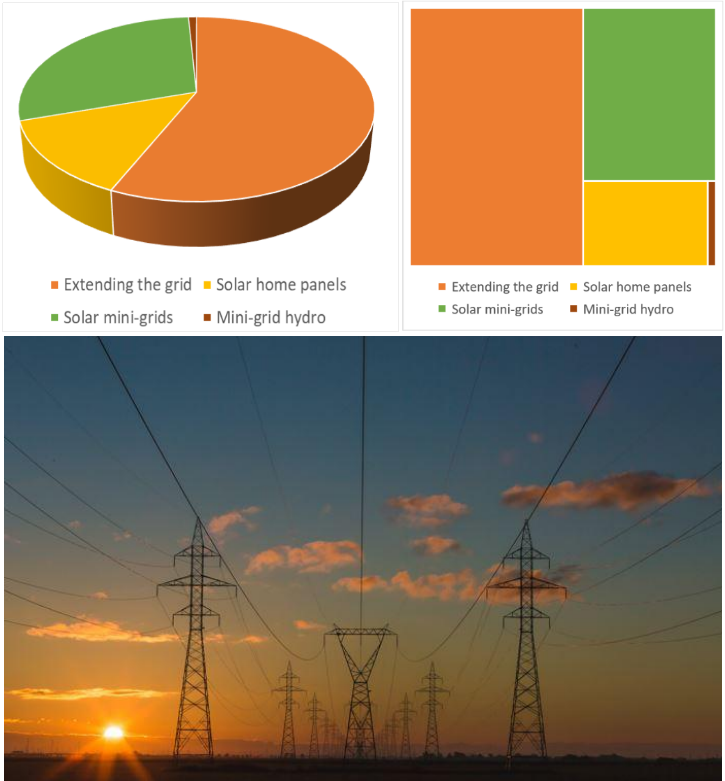
So what is the best technology mix to fully power up Luilu? Considering the existing grids from mining companies in Luilu and Kolwezi, extending these grids emerges as the most cost-efficient solution. Our calculations indicate that 58% of the projected nearly 430 thousand residents in Luilu by 2030 could be electrified with this technology. Other technologies make up the rest of the mix: solar mini-grids (29%), solar home panels (13%), and mini-grid hydro (1%).
Future Technology Mix
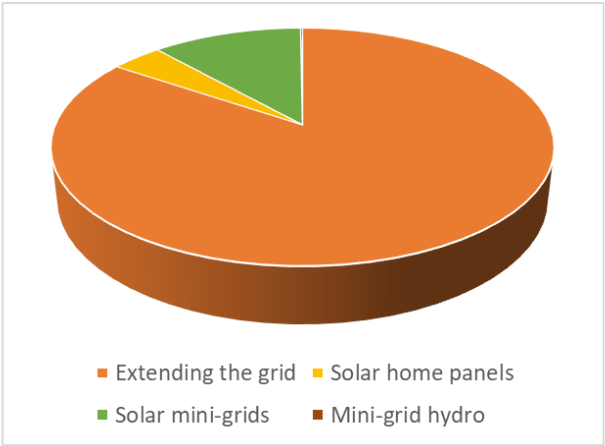
The power generation breakdown reveals a significant emphasis on extending the grid, capturing a substantial 85% share. In contrast, solar home panels contribute a modest 4%, while solar mini-grids claim an 11% stake. Mini-grid hydro, on the other hand, holds a negligible percentage in this overall distribution, less than 1%.
Future Investments
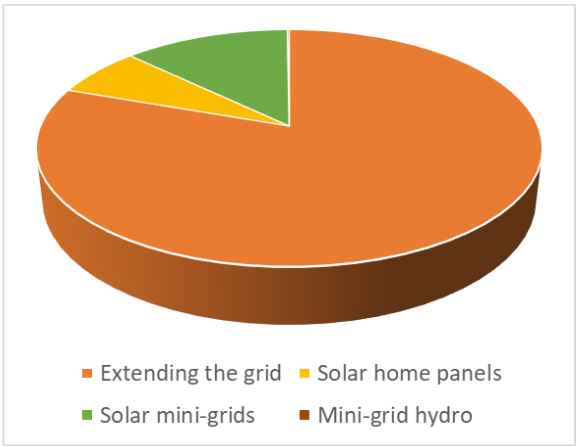
How much would it cost to make this happen? It will take 144 USD million to bring full electrification to Luilu over a period of 10 years, i.e. 20 USD million a year. The good news is that the mining royalties that the municipality receives cover an important sum of this dividend. In 2021 Luilu perceived 6.9 USD million, which would cover around 35% of the needed amount. Even better, according to our calculations, Luilu should have received 29 USD million in the same year if all companies present there paid what we estimated. The investment distribution is primarily focused on grid infrastructure, claiming a substantial 80%. The remaining allocation for other technologies breaks down as follows: 13% for solar mini-grids, 7% for solar home panels, and a minor 0.10% for hydro mini-grids.
Conclusions and What's to Come
In conclusion, when it comes to lighting up Luilu, putting more effort and investments into renewable energy is the smart move. Relying on diesel is not the best call, even with a price far from extremely high. Moreover, the numbers show that Luilu has already some of the financial resources necessary to bankroll an electrification plan from mining revenues. Bottom line: it's time to go green for Luilu's power – not just a good idea for the environment but also for the pocket. How to get there more concretely? We are modelling what will it take to develop a solar mini-grid a Luilu village, including necessary investments and power to generate. We’ll share the results in the coming months.
Have questions or feedback? Get in touch!